
Ongoing airspace closures and regional port disruption in the Middle East are affecting global air and ocean trade lanes.
Heightened security concerns around the Strait of Hormuz have led some carriers to divert vessels, revise rotations, temporarily pause transits, or suspend new bookings. As military activity increases uncertainty, routing decisions are being reassessed in real time.
Air freight is facing similar pressure. Flight cancellations, rerouted services, and extended flight paths are becoming more common as airlines adapt to restricted airspace. Longer routes mean higher fuel burn and rising operating costs. Capacity adjustments, in turn, are putting additional strain on schedule reliability.
The Middle East sits at the center of global energy flows, petrochemical exports, and major east–west trade lanes. When routing decisions shift, volumes and schedules shift with them. Transshipment hubs absorb redirected cargo. Substitute airports take on unexpected connections. Downstream schedules tighten.
What begins as localized instability can quickly become network-wide exposure.
For freight forwarders, this is the difference between monitoring disruption and actively managing deviation across active shipments.
- The operational questions are immediate:
- Which shipments are exposed to cancelled flights or rerouted vessels?
- Which airport gateways or port calls are affected?
- How will rerouting impact downstream milestones?
- How should customers be informed before disruption compounds?
What the data is already showing
Across the CargoWise network, the effect of disruption is measurable.
Aggregated, anonymized CargoWise data indicates that as of 5 March 2026:
- ~33,700 ocean jobs were disrupted across approximately ~200 vessels, reflecting altered rotations, rerouted voyages, and schedule changes.
- ~11,000 air shipments were disrupted, representing a 4.3% air shipment disruption rate during the same period.
Notably, the impact is not confined to the Middle East. As carriers adjust routing decisions, disruption is surfacing across the Americas, EMEA, and APAC. This indicates how quickly volatility in one region cascades through interconnected global trade lanes.
The scale of disruption reflects active cargo flows being rerouted and rescheduled in response to external conditions, not a contraction in overall demand.
Explore our interactive situation report to see where disruption is concentrated and how shipment impact is evolving across the CargoWise network.
Turning disruption into shipment-level visibility
While headlines may signal risk, they cannot define operational impact.
Airspace closures and vessel diversions often influence transit times and arrival schedules before formal service updates are issued. Congestion can build at alternative hubs long before cancellations are confirmed.
Manually tracking these developments across thousands of shipments is not scalable. More importantly, fragmented alerts lack context. A regional escalation only becomes operationally meaningful when it is tied to a specific flight segment, port call, or milestone within an active routing plan.
CargoWise now incorporates AI-powered incident intelligence directly into day-to-day ocean and air workflows. Rather than interpreting external alerts in isolation, teams can see how emerging risk signals align with live shipments.
The emphasis moves beyond passively monitoring events to enabling customers to identify which shipments are at risk within CargoWise and what action needs to be taken next.
Assessing ocean exposure at the port level
As vessel movements through and around the Strait of Hormuz are suspended or rerouted, carriers are adjusting rotations with little notice. Port calls are being skipped. Arrival windows are shifting. Transshipment sequences are changing as volumes are redirected to alternative gateways.
For forwarders, this creates uncertainty at the intermediate stop level — often before formal schedule revisions are widely communicated.
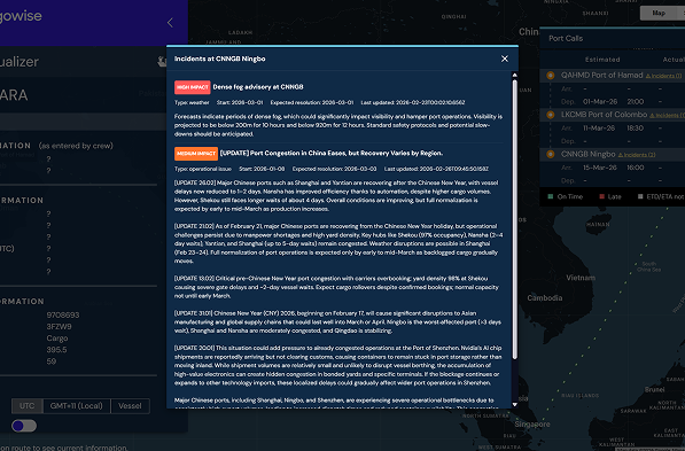
Route Visualizer allows teams to examine planned vessel calls and assess exposure port by port. Port-level intelligence provides contextual insight into geopolitical developments affecting maritime corridors such as the Strait of Hormuz, navigation and security advisories, congestion indicators, regulatory measures, and severe weather conditions. This allows forwarders to evaluate whether a specific port call or intermediate stop presents emerging risk before schedule revisions are formally issued.
This is particularly critical where:
- A vessel bypasses a Gulf port and shifts onward sequencing
- Feeder connections depend on narrow discharge windows
- Substitute hubs begin absorbing diverted volumes
- Inland movements are tied to expected arrival milestones
Waiting for a formal ETA revision often means you're already behind. Reviewing routing changes earlier allows teams to prepare customers and adjust plans before delays ripple outward.
Strengthening air execution under airspace restrictions
As airspace restrictions expand across parts of the Middle East, airlines are cancelling services, rerouting flights and extending flight paths to continue their operations and avoid restricted airspace. Airline schedules and services are being revised at short notice with connections being reshaped across affected trade lanes.
For forwarders, uncertainty often begins before a flight is formally cancelled. Transit times may lengthen. Cutoff times shift. Capacity tightens as aircraft rotations are adjusted across adjacent corridors.
These risks typically surface in scenarios such as:
- A booked flight is cancelled and cargo must be rolled to a later departure
- Extended routings increase transit time beyond committed delivery windows
- Multi-leg routings depend on narrow transfer windows at hub airports
- Capacity tightening introduces rebooking delays or space constraints
Instead of reacting after a missed connection or failed milestone, operators need visibility into these changes as they unfold.
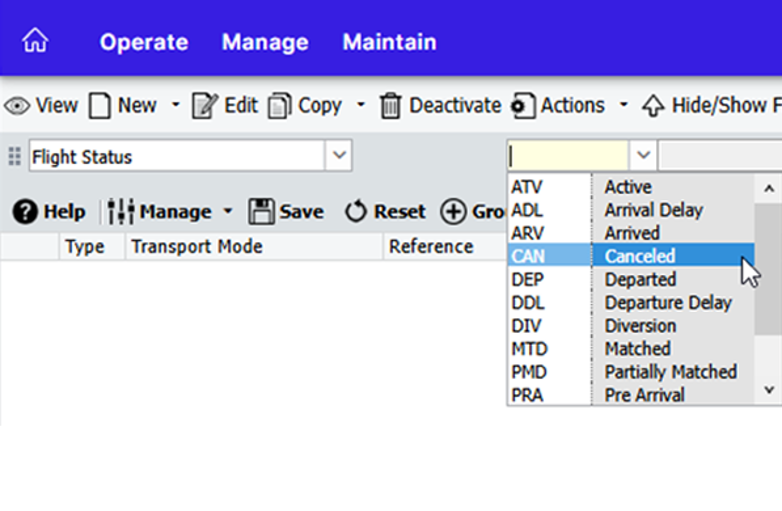
The sending of Cancelled Flight Status events has been activated within AWB Automation and is now automatically reflected against impacted air consolidations as airlines report cancellations.
Within CargoWise, workflow rules can be configured to trigger immediate alerts based on these events, enabling teams to assess impacted air consolidations and initiate alternative arrangements without delay.
You can learn more about Flight Status Visibility on Air Routing Legs and Consolidations to understand how cancellations and rerouting are surfaced against active consignments.
Air shipments can also be rebooked directly with airlines through AirlineConnect, which provides real-time schedules and capacity from connected airline systems.
When flights are cancelled, confirmed bookings made via AirlineConnect are automatically updated within the affected air consolidation, increasing transparency and reducing manual intervention.
Connecting global events to operational decisions
Over the past week alone, routing adjustments in one trade lane have triggered congestion and capacity shifts elsewhere, underscoring how quickly localized geopolitical events lead to disruption across global networks.
Maritime rerouting increases congestion at alternative transshipment hubs. Airspace closures reduce available capacity across connected trade lanes. As carriers reassess exposure, cost structures may shift mid-transit, adding commercial complexity to operational disruption.
Consequences extend beyond schedules. Service levels tighten, contractual obligations are tested, and financial exposure increases as delays accumulate. In volatile conditions, the greater risk is often how long those pressures go unseen.
By embedding disruption intelligence directly into active ocean voyages and air shipments, CargoWise enables forwarders to identify exposure earlier, communicate with greater confidence, and make informed operational and commercial decisions before impacts compound.
Over time, this deeper, shipment-level awareness strengthens execution across complex supply chains — helping teams not only track movements, but better understand the conditions shaping them.
Disclaimer
All figures referenced are indicative only and based on aggregated, anonymized CargoWise data. They do not reflect the operations, volumes or exposure of any individual customer, shipment or organization.
Explore our interactive situation report
See where disruption is concentrated and how shipment impact is evolving across the CargoWise network.
Todas as notícias
Últimas notícias
Vamos nos conectar
Descubra como o CargoWise pode ajudar você a eliminar os entraves da logística.